Cite this work
Mas-Buitrago et al. (2026).
Euclid: Quick Data Release (Q1) -- Exploring the detailed visual morphology of galaxies in clusters. arXiv,
.
@ARTICLE{2026arXiv260908962M,
   author = {{Mas-Buitrago}, P. and {Kruk}, S. and {O'Ryan}, D. and {Nardone}, M.~T. and {La Marca}, A. and {Awad}, P. and {Baes}, M. and {Fossati}, M. and {G{\'e}ron}, T. and {Ghaffari}, Z. and {Girardi}, M. and {Lintott}, C.~J. and {Sorce}, J.~G. and {Altieri}, B. and {Durret}, F. and {Pettorino}, V. and {Irureta-Goyena}, B.~Y. and {Simmons}, B. and {Reerink}, J. and {Dom{\'\i}nguez S{\'a}nchez}, H. and {Knapen}, J.~H. and {Shankar}, F. and {Duran-Camacho}, E. and {P{\'e}rez-Mart{\'\i}nez}, J.~M. and {Walmsley}, M. and {Auricchio}, N. and {Baccigalupi}, C. and {Baldi}, M. and {Bardelli}, S. and {Battaglia}, P. and {Biviano}, A. and {Bolzonella}, M. and {Bonchi}, A. and {Branchini}, E. and {Brescia}, M. and {Brinchmann}, J. and {Camera}, S. and {Ca{\~n}as-Herrera}, G. and {Capobianco}, V. and {Carbone}, C. and {Carretero}, J. and {Castellano}, M. and {Castignani}, G. and {Cavuoti}, S. and {Cimatti}, A. and {Colodro-Conde}, C. and {Congedo}, G. and {Conselice}, C.~J. and {Conversi}, L. and {Copin}, Y. and {Costille}, A. and {Courbin}, F. and {Courtois}, H.~M. and {Cropper}, M. and {Degaudenzi}, H. and {De Lucia}, G. and {Dole}, H. and {Dubath}, F. and {Dupac}, X. and {Dusini}, S. and {Ealet}, A. and {Fabricius}, M. and {Farina}, M. and {Farinelli}, R. and {Ferriol}, S. and {Fosalba}, P. and {Fotopoulou}, S. and {Frailis}, M. and {Franceschi}, E. and {Fumana}, M. and {Galeotta}, S. and {George}, K. and {Gillis}, B. and {Giocoli}, C. and {G{\'o}mez-Alvarez}, P. and {Gracia-Carpio}, J. and {Grazian}, A. and {Grupp}, F. and {Gwyn}, S. and {Holmes}, W. and {Hook}, I.~M. and {Hormuth}, F. and {Hornstrup}, A. and {Huertas-Company}, M. and {Jahnke}, K. and {Jhabvala}, M. and {Joachimi}, B. and {Kermiche}, S. and {Kiessling}, A. and {Kubik}, B. and {K{\"u}mmel}, M. and {Kunz}, M. and {Kurki-Suonio}, H. and {Le Brun}, A.~M.~C. and {Ligori}, S. and {Lilje}, P.~B. and {Lindholm}, V. and {Lloro}, I. and {Mainetti}, G. and {Mansutti}, O. and {Marggraf}, O. and {Martinelli}, M. and {Martinet}, N. and {Marulli}, F. and {Massey}, R.~J. and {Maurogordato}, S. and {Medinaceli}, E. and {Melchior}, M. and {Meneghetti}, M. and {Merlin}, E. and {Meylan}, G. and {Mora}, A. and {Moresco}, M. and {Moscardini}, L. and {Munari}, E. and {Neissner}, C. and {Niemi}, S.-M. and {Nightingale}, J.~W. and {Padilla}, C. and {Paltani}, S. and {Pasian}, F. and {Pedersen}, K. and {Percival}, W.~J. and {Pezzotta}, A. and {Pires}, S. and {Polenta}, G. and {Poncet}, M. and {Popa}, L.~A. and {Pozzetti}, L. and {Raison}, F. and {Renzi}, A. and {Rhodes}, J. and {Riccio}, G. and {Romelli}, E. and {Roncarelli}, M. and {Rusholme}, B. and {Saglia}, R. and {Sakr}, Z. and {S{\'a}nchez}, A.~G. and {Sapone}, D. and {Sartoris}, B. and {Schneider}, P. and {Schrabback}, T. and {Scodeggio}, M. and {Secroun}, A. and {Sihvola}, E. and {Simon}, P. and {Sirignano}, C. and {Sirri}, G. and {Tallada-Cresp{\'\i}}, P. and {Taylor}, A.~N. and {Teplitz}, H.~I. and {Tereno}, I. and {Tessore}, N. and {Toft}, S. and {Toledo-Moreo}, R. and {Torradeflot}, F. and {Tutusaus}, I. and {Valiviita}, J. and {Vassallo}, T. and {Verdoes Kleijn}, G. and {Veropalumbo}, A. and {Wang}, Y. and {Weller}, J. and {Zacchei}, A. and {Zamorani}, G. and {Zerbi}, F.~M. and {Zucca}, E. and {Macias-Perez}, J. and {Sereno}, M.},
    title = "{Euclid: Quick Data Release (Q1) -- Exploring the detailed visual morphology of galaxies in clusters}",
  journal = {arXiv e-prints},
 keywords = {Astrophysics of Galaxies},
     year = 2026,
    month = sep,
      eid = {arXiv:2609.08962},
    pages = {arXiv:2609.08962},
      doi = {10.48550/arXiv.2609.08962},
archivePrefix = {arXiv},
    eprint = {2609.08962},
primaryClass = {astro-ph.GA},
    adsurl = {https://ui.adsabs.harvard.edu/abs/2026arXiv260908962M},
    adsnote = {Provided by the SAO/NASA Astrophysics Data System}
    }
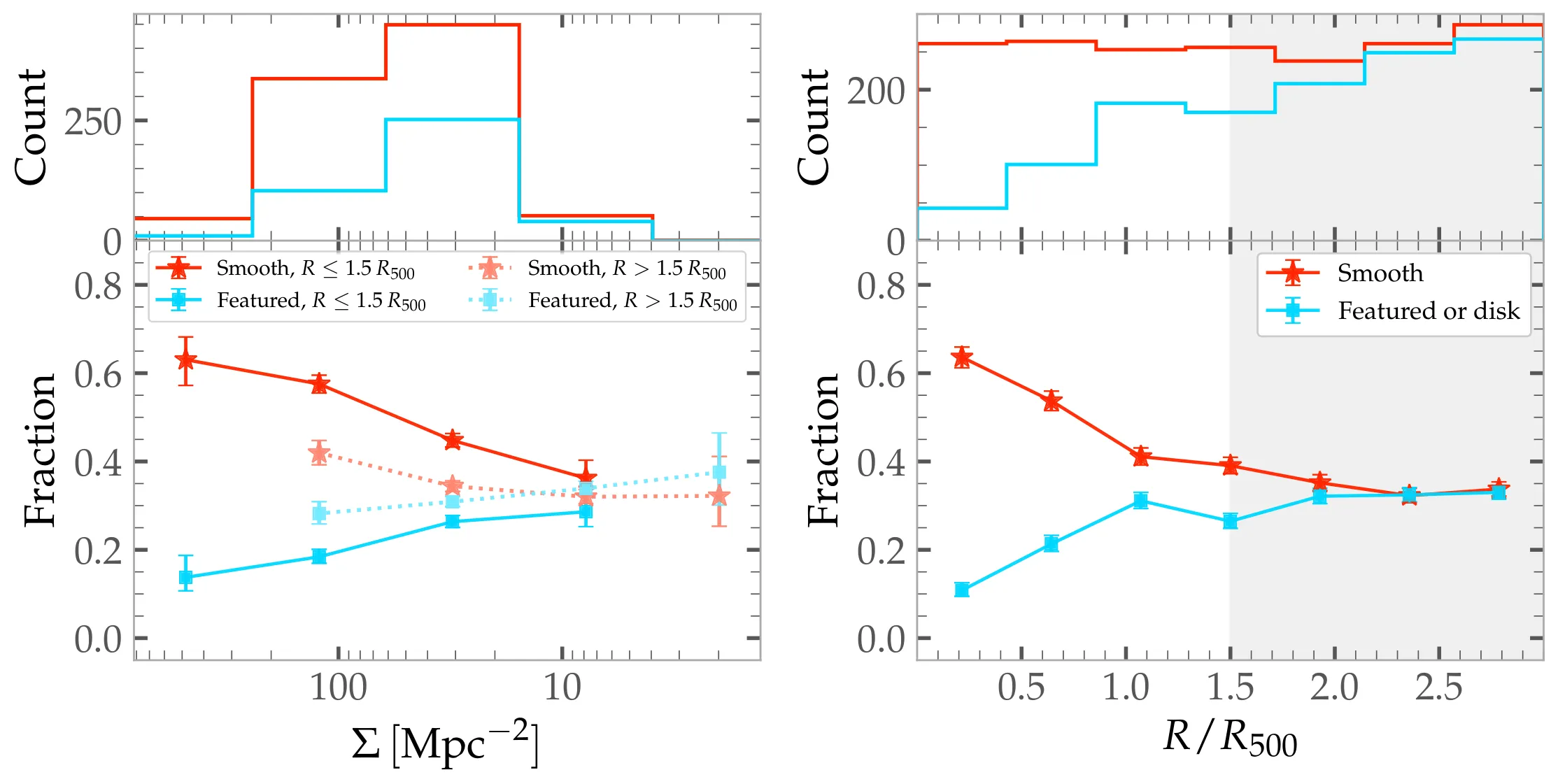
Using the first data release of ESA’s Euclid mission and the Zoobot deep learning model, we studied how the dense environments of galaxy clusters shape the morphology of their galaxies. Across 71 clusters at 0.2 ≤ z ≤ 0.5, we find that galaxies lose their disc structure progressively towards the densest regions and the cluster core, where environmental processes act most efficiently, and we find tentative evidence that bars become more common in denser environments, especially in massive galaxies.
Galaxy clusters provide unique laboratories for studying environmental effects on galaxy evolution. The morphology—density (T—Σ) and morphology—cluster-centric radius (T—R) relations trace how galaxy morphology is influenced by the environment, but previous studies at intermediate redshifts have been limited in both sample size and radial coverage. We use the Euclid Quick Data Release 1 (Q1) visual morphology catalogue to measure the T—Σ and T—R relations for smooth, featured-or-disc, and barred galaxies in known clusters at 0.2≤z≤0.5, extending this analysis to large cluster-centric distances (3R500c) and studying their dependence on stellar mass. Using photometric redshifts and stellar masses provided by \Euclid, we identify 1754 cluster members within 1.5R500c, distributed across 71 clusters. We classify the identified galaxies as smooth, featured-or-disc, or barred using the predicted vote fractions provided by the \Zoobot deep learning foundation model in the Q1 visual morphology catalogue. Our \Zoobot classification of smooth and featured-or-disc galaxies is similar to the separation between elliptical and disc galaxies. We confirm the T—Σ relation in all the stellar mass ranges studied, with a stronger influence of the cluster environment on galaxy morphology in the densest parts of the cluster and closer to the cluster centre. Beyond 1.5R500c, the morphological segregation weakens, with featured-or-disc galaxies overtaking smooth galaxies at the lowest densities, consistent with the growing contribution of field interlopers in the cluster outskirts. For barred galaxies, we find a tentative decline of the bar fraction toward lower densities that is most pronounced for the most massive galaxies. In conclusion, our results show that the cluster environment drives a progressive transformation of galaxy morphology, with the loss of disc structure becoming more pronounced towards the cluster core, where environmental processes act most efficiently. These findings, enabled by the unique characteristics of the Q1 visual morphology catalogue, advance our physical understanding of how galaxies evolve in dense environments at intermediate redshifts.