
Cite this work
In this work, published in Astronomy & Astrophysics, we present the power of the Spanish Virtual Observatory Filter Profile Service and associated photometric tools, and demonstrate their power to segregate FGK dwarf and giant stars using narrow-band photometry. Using machine-learning techniques such as the Gaussian mixture model and the support vector machine algorithms, we defined several criteria based on J-PAS colours to discriminate between dwarf and giant stars, selecting the five most promising colour-colour diagrams for this task and defining a criteria to maximise the separation.
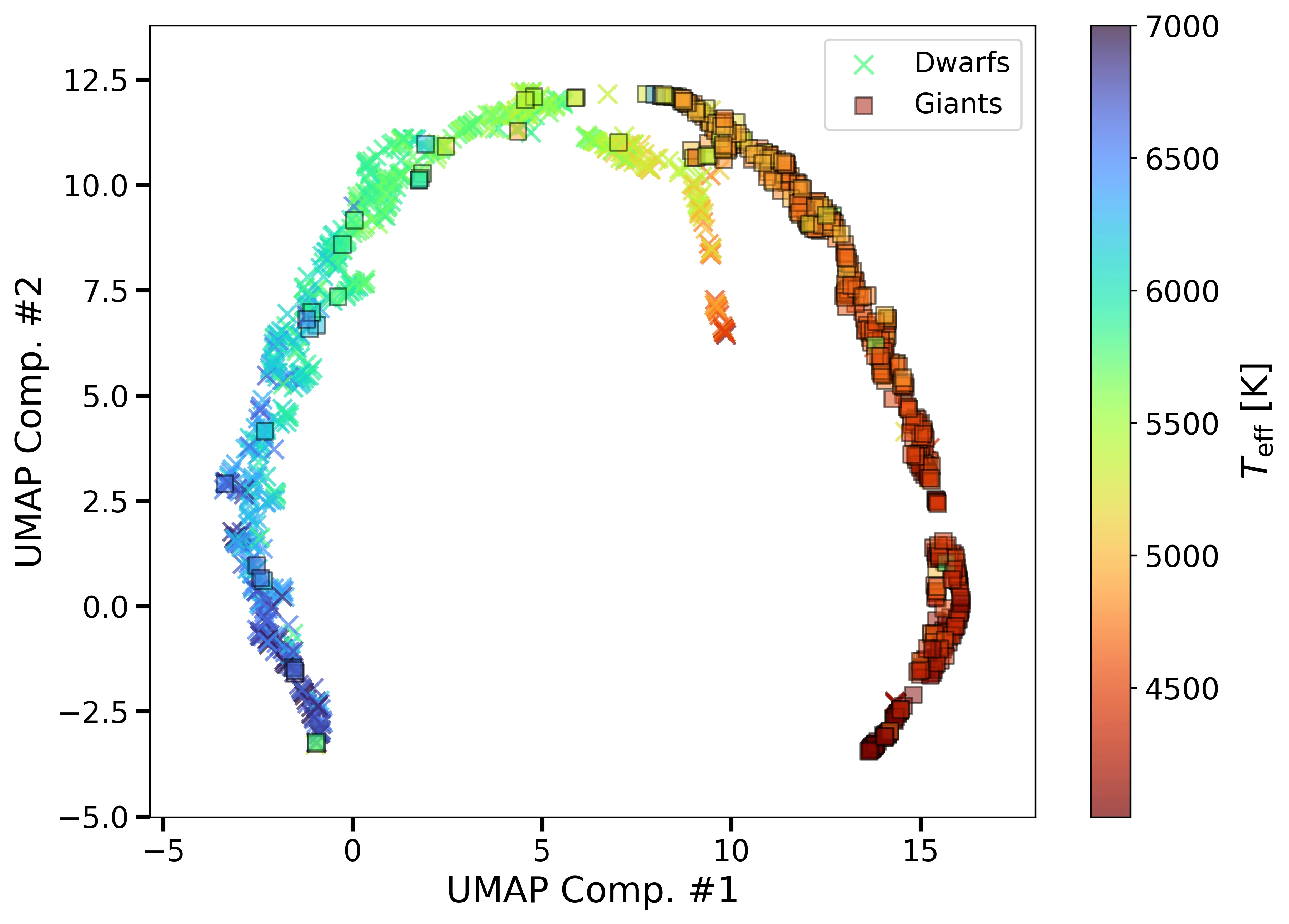
Two-dimensional UMAP projection of our sample of giants (filled squares with darker contours) and dwarfs (crosses), colour-coded by effective temperature. Although there is an overlap for temperatures above 5500 K approximately, both classes are clearly distinguishable for lower temperatures.
Abstract
Aims. This paper is focused on the segregation of FGK dwarf and giant stars through narrow-band photometric data using the Spanish Virtual Observatory (SVO) Filter Profile Service and associated photometric tools.
Methods. We selected spectra from the MILES, STELIB, and ELODIE stellar libraries, and used SVO photometric tools to derive the synthetic photometry in 15 J-PAS narrow filters, which were especially selected to cover spectral features sensitive to gravity changes. Using machine-learning techniques as the Gaussian mixture model and the support vector machine, we defined several criteria based on J-PAS colours to discriminate between dwarf and giant stars.
Results. We selected five colour-colour diagrams that presented the most promising separation between both samples. Our results show an overall accuracy in the studied sample of ~0.97 for FGK stars, although a dependence on the luminosity type and the stellar effective temperature was found. We also defined a colour-temperature relation for dwarf stars with effective temperatures between 4 000 and 7 000 K, which allows one to estimate the stellar effective temperature from four J-PAS filters (J0450, J0510, J0550, and J0620). Additionally, we extended the study to M-type giant and dwarf stars, achieving a similar accuracy to that for FGK stars.