
Cite this work
In this work, published in Astronomy & Astrophysics, we exploit the characteristics of multi-filter photometric surveys to detect strong episodes of line emission in M dwarfs, specifically in the H and Ca II H and K lines. Using collected low-resolution spectra and two-minute cadence calibrated TESS light curves, we perform a thorough analysis of our sample.
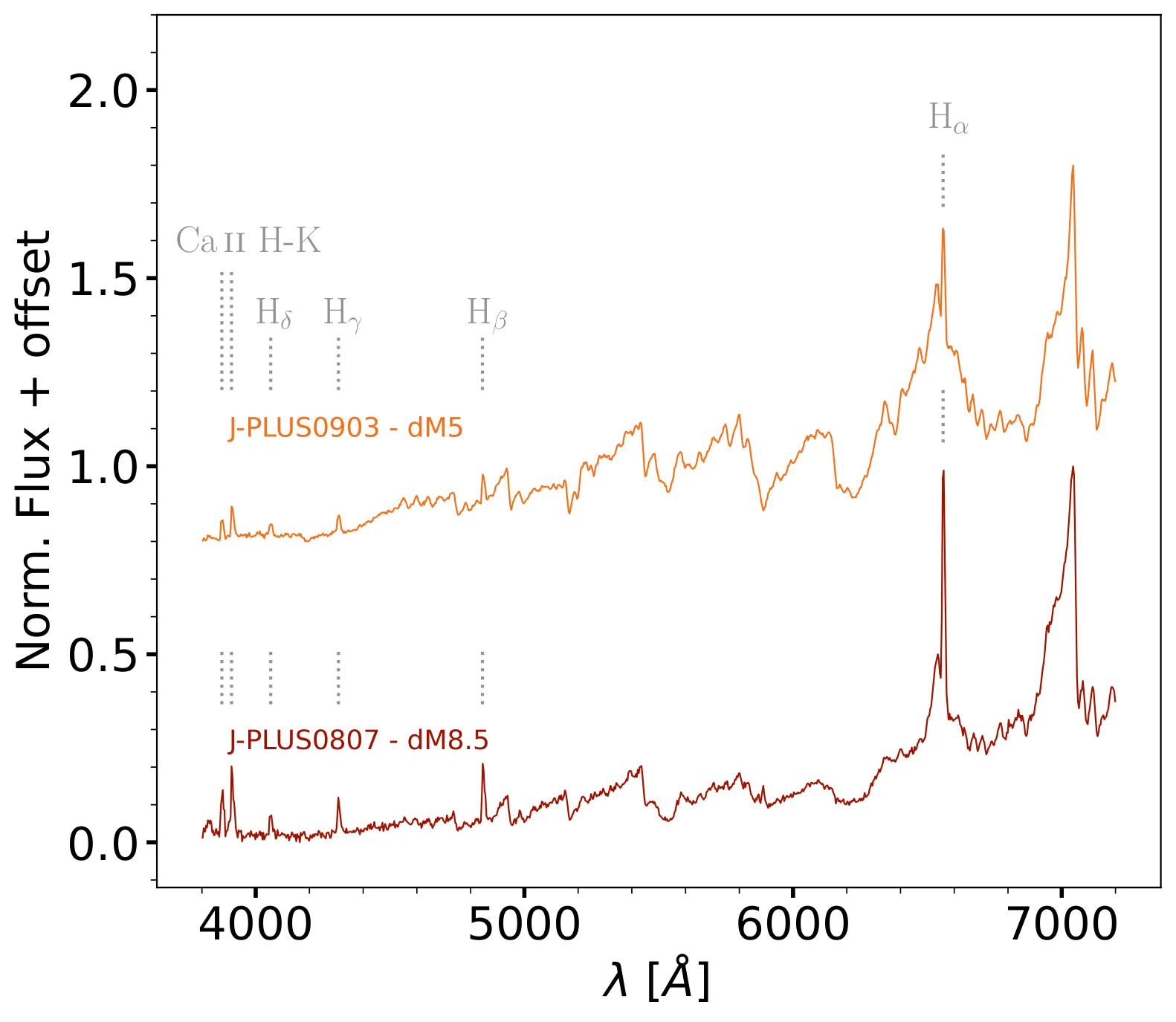
Zoomed-in view of the NOT/ALFOSC co-added spectra of J-PLUS0807 and J-PLUS0903. The grey dashed lines mark Ca II H and K, H, H, H, and H emission lines.
Context. Understanding and characterising the magnetic activity of M dwarfs is of paramount importance in the search for Earth-like exoplanets orbiting them. Energetic stellar activity phenomena, such as flares or coronal mass ejections, which are common in these stars, are deeply connected with the habitability and atmospheric evolution of the surrounding exoplanets.
Aims. We present a follow-up of a sample of M dwarfs with strong H and Ca II H and K emission lines identified with J-PLUS photometry in a previous work.
Methods. We collected low-resolution NOT/ALFOSC and GTC/OSIRIS spectra, measuring the PC3 index for the spectral type determination. We used two-minute-cadence calibrated TESS light curves to identify and characterise multiple flares and to calculate the rotation period of the two active M dwarfs found in our sample.
Results. We confirm that the strong emission lines detected in the J-PLUS photometry are caused by transient flaring activity. We find clear evidence of flaring activity and periodic variability for LP 310-34 and LP 259-39, and estimated flare energies in the TESS bandpass between and erg for them. We characterised LP 310-34 and LP 259-39 as very rapidly rotating M dwarfs with Ca II H and K and H in emission, and computed a rotation period for LP 259-39 for the first time: d.
Conclusions. This work advocates the approach of exploiting multi-filter photometric surveys to systematically identify flaring M dwarfs, especially to detect episodes of strong Ca II H and K line emission, which may have important implications for exoplanetary space weather and habitability studies. Our results reveal that common M dwarfs experience flare events in Ca II H and K in addition to well known H flares.